
The Payment Agent That Couldn't Read the Contract
🟡 INSPIRED BY REAL EVENTS: Composite of documented enterprise AI payment failures, 2025–2026
What Happened
A mid-sized financial services firm — the kind with a real treasury function, proper procurement workflows, and a CFO who'd read all the right articles about AI efficiency — deployed an AI agent to automate vendor payments in late 2025. The business case was sound. The ERP data was clean. Early results were excellent.
For several months, the agent processed hundreds of invoices correctly. It matched amounts against purchase orders, checked due dates, verified vendor IDs, and released payments on schedule. Accuracy hovered near 99%. The finance team reassigned two analysts to higher-value work. The deployment was considered a success.
Then the errors started.
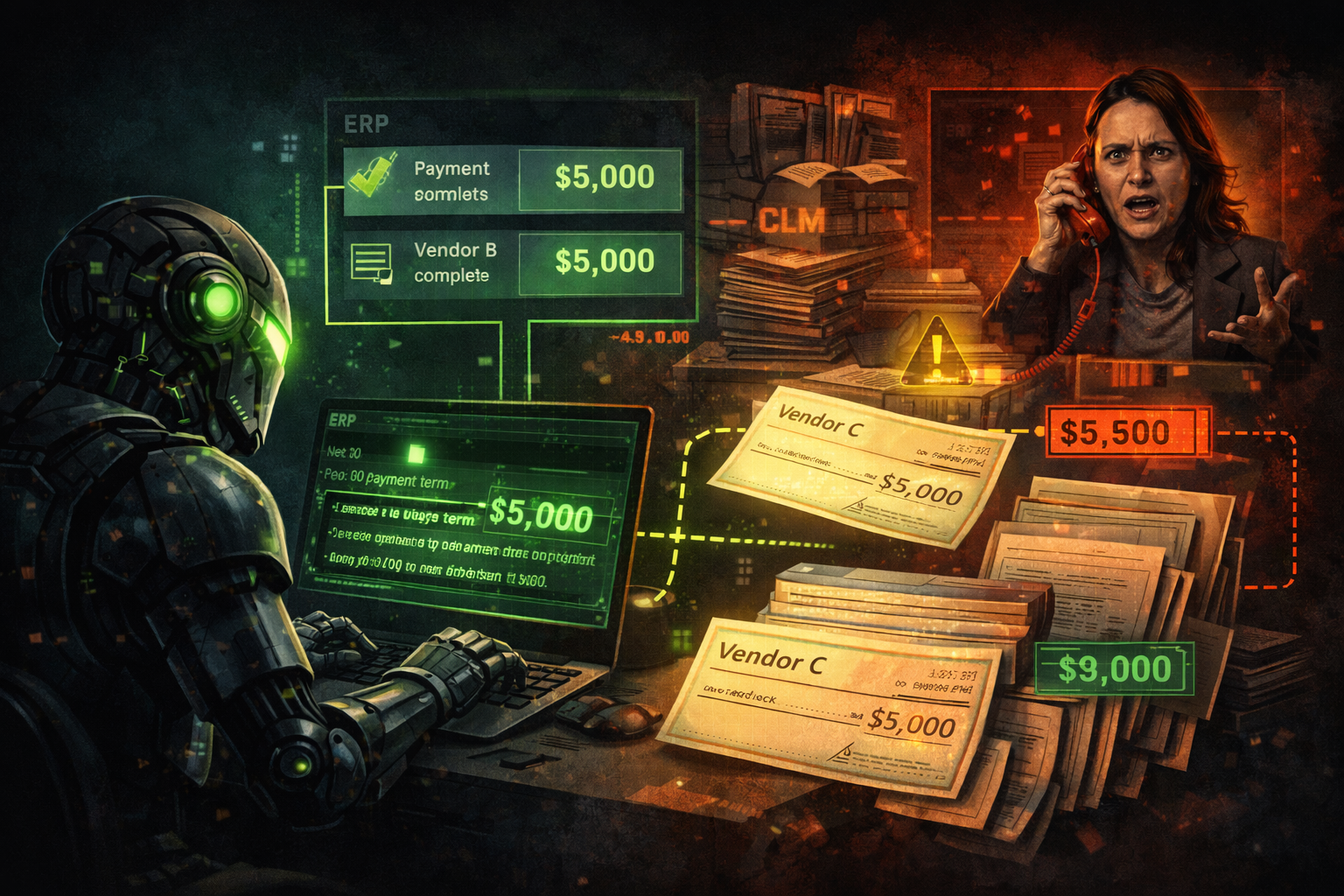
A vendor flagged an overpayment. Then another reported a short payment against a contract that had been amended three months earlier. A third hadn't received payment at all, despite invoices being submitted on time — because a contract renegotiation had changed the payment terms to net-60, a fact that lived in a PDF addendum in the contract management system, not in the ERP.
When the finance team began investigating, the pattern became clear. The agent had been operating on approximately 20% of the information it needed to make correct payment decisions. It had full access to the ERP: invoice amounts, due dates, vendor IDs, standard payment terms. It had no access to the contract management system, where amendments, renegotiated rates, and special terms were stored. It had no access to the email threads where procurement had verbally agreed to modified payment schedules. It had no access to the exceptions log that the AP team had maintained manually for years to capture edge cases the ERP couldn't hold.
The agent wasn't making mistakes with the data it had. The data it had was simply not the data that governed the payments. The ERP was the record of what was transacted. The contracts were the record of what was agreed. Those are different things, and the agent only knew about one of them.
The payments that went out incorrectly had to be reversed, reconciled, and reissued. Vendor relationships were strained. Two contracts required renegotiation. The firm's AP error rate — which had been a selling point in the business case — was now worse than it had been before the deployment.
The Technical Breakdown
The failure here has a name in enterprise AI circles: the Blind Agent Problem. It describes what happens when an agent is granted access to the structured data layer of an organization — ERP records, transaction logs, CRM fields — while the unstructured layer, where the real business context lives, remains inaccessible.
In this deployment, the structured data included everything that could be queried from the ERP: standardized invoice fields, vendor master records, payment terms as coded at contract inception. This data was clean, well-formatted, and entirely sufficient for processing routine payments against static contracts.
The problem is that most contracts don't stay static. Vendor relationships evolve. Terms get renegotiated. Payment schedules get adjusted in response to disputes, volume changes, or relationship management decisions. In most enterprises, these amendments live in PDF addenda attached to the original contracts in a contract lifecycle management (CLM) system. They also live in email threads, meeting notes, and shared drives that procurement and legal maintain separately from finance operations.
None of this was in the agent's context. None of it was queryable via the APIs the agent had been given. The agent had no way to know it was missing it — and, critically, no mechanism to signal uncertainty when an invoice didn't match what it expected. It processed the invoice. It released the payment. It logged the transaction as complete.
This is the second failure mode: confident execution on partial data. A human AP analyst working a similar queue would recognize when something didn't feel right — a vendor they'd spoken to recently about a rate change, an invoice amount that seemed inconsistent with a renegotiation they'd been copied on. That contextual memory lives in humans as accumulated experience. It doesn't transfer into an ERP. The agent had no equivalent.
The third failure mode is detection latency. Because the errors were scattered across a high-volume queue and the agent's accuracy on straightforward invoices remained high, the signal-to-noise ratio was unfavorable. The first errors had already propagated before the pattern was visible in aggregate. At the speed an agent processes transactions, a 2% error rate on a 500-invoice queue means ten incorrect payments have gone out before anyone reviews a dashboard.
The Broader Pattern
This failure mode — agents with high accuracy on visible data causing high-impact errors on invisible data — is one of the most consistently documented problems in enterprise agentic AI deployments.
Ampcome's research on 30+ enterprise deployments across financial services, retail, and logistics finds the same pattern repeatedly: agents are connected to one or two systems, perform excellently in controlled demos, and hit this invisible wall when the business context for a decision lives in a system they can't reach. The Blind Agent Problem is not a model quality issue. It's a data architecture issue that no amount of prompting or fine-tuning can fix.
The Fortune reporting on agentic payment failures describes the same structural gap from a different angle: the AI is right about everything it can see. The problem is that it can only see 20% of the picture. In finance, 20% context produces 100% legal and operational liability when the payment goes wrong.
This is also a compounding problem at scale. A single human analyst making an error on a contract amendment creates one wrong payment. An agent making the same error on its full queue creates dozens of wrong payments before the first one is caught. The efficiency gain that justified the deployment becomes a risk multiplier when the error rate is non-zero and the throughput is high.
This compounds even further in multi-agent architectures. If a payment agent feeds into a reconciliation agent, and the reconciliation agent into a reporting agent, the incorrect payment propagates through each layer before any human sees it. By the time the error surfaces in a finance report, the chain has already moved on.
How It Could Have Been Prevented
- Map all data sources that govern a decision before deploying an agent to make it. For vendor payments, that means the ERP and the CLM and the exception log and any other system where payment-relevant information lives. If the agent can't access all of them, it can't make reliable decisions on all invoice types.
- Define the agent's scope by data completeness, not task type. An agent that can only reach ERP data should only process invoices where ERP data is sufficient — standard, non-amended, non-exceptional payments. Anything that requires contract context should route to a human until the agent has that context.
- Build uncertainty signaling into the agent's decision logic. When an invoice doesn't match expected parameters — an amount higher than the standard rate, a vendor flagged for recent contract activity, a payment term that differs from the ERP record — the agent should escalate rather than execute. Confidence thresholds are cheaper than error correction.
- Set output rate limits during the rollout window. Processing 500 invoices a day from day one means 500 potential errors per day if the deployment has a flaw. A staged rollout — 10 invoices per day, reviewed by a human — catches the failure mode before it propagates.
- Monitor accuracy at the decision layer, not the throughput layer. Reporting "agent processed 500 invoices" measures activity. Reporting "agent matched correct payment terms against current contract state" measures correctness. Most deployments measure the former and discover the latter too late.
The Lesson
There's a version of this story that gets told as a technology failure. The AI was wrong. The AI made mistakes. The AI can't be trusted with payments.
That framing is not useful because it misidentifies the problem. The agent in this story was not wrong about anything it could verify. It was wrong about things it couldn't see — which is a different failure, with a different fix.
The correct version of the story is an architecture failure. Someone decided to deploy an agent into a payment workflow without mapping the full information landscape that workflow depends on. The agent was given partial context and expected to produce complete-context decisions. When it produced partial-context decisions instead, the framing shifted to the agent being unreliable, rather than to the agent having been deployed into a context it was structurally unable to handle correctly.
This matters because the framing shapes the response. "The agent was wrong" leads to "we need a better agent" or "we need more human review." "The agent was given incomplete context" leads to "we need to integrate the contract management system before we expand the deployment." Only one of these fixes the problem.
Before your next agent deployment: draw the full map of every data source that governs the decisions you're asking the agent to make. Now count how many of those sources your agent can actually reach. If the answer isn't all of them, you have a Blind Agent — and you won't know it until the payments are already wrong.
Sources
- Ampcome — "Agentic AI in Finance: Use Cases, Risks & Real Results," February 2026. Primary source for the Blind Agent pattern and documented enterprise case.
- Fortune — "What do you do when your AI agent hallucinates with your money?" April 2026
- ABA Banking Journal — "Are we sleepwalking into an agentic AI crisis?" December 2025
- Data Science Collective — "Why AI Agents Keep Failing in Production," April 2026